Showing posts with label dog. Show all posts

06 May 2009

What Chinese food really is

What do people eat in China? Almost certainly, nothing that resembles what you can buy from your local Chinese takeaway back home.

One myth that needs to dispelled is that fact that dog meat is widely eaten. First off, China is massive - it's the size of a continent. You can't tar over a billion people with the same brush. Some people here do eat dog. Those people generally live in the far northeast of China (since I understand eating dog meat is predominantly a Korean practise), and in the far south of China (Cantonese people). As far everyone else.... Well, to be honest, it is actually very difficult to find dog meat. There are a few restaurants that include dog on the menu, but if you ask about it they very rarely have it. Also, dog meat is considered "winter food", since it is said to have a warming effect onthe body. I have to confess here, I did manage to track down a restaurant that sold it. I tried it.... it's just meat. Didn't taste weird, it's just meat. However, I did find it to be full of bones and gristle, and for that reason I won't be eating it again. 

Getting back on topic though, there are only a few things that you can find back home that can also be bought here. (I think the dish that's the closest to being the same on all continents is sweet and sour pork. But just don't ask for sweet and sour chicken/beef/prawns, since this will be met with a mixture of confusion and disgust.) So... what do people eat? It varies a lot from place to place, with each province staking claim to its own unique dishes and flavours. Here in Shaanxi province, here are two of the most popular:

Liang pi. This is basically cold noodles, covered in chilli oil. Somewhat amusingly, you can also get "hot cold noodles", which I like to call "noodles".

This one is a very commonly-seen snack in Xi'an - rou jia mo (meat and bread). Its often called a "Chinese hamburger" by Chinese english-speakers. Usually, this is stewed mutton (though sometimes beef) and gravy put inside some flat bread. Awesome.

21 April 2009

The International Language of Onomatopoeia

(Or: Would a duck by any other quack sound as sweet?)

There are certain things in life that people often take for granted. The sun rises and sets. Santa will only leave gifts for good boys and girls. Grass is green. The sky is blue. Dogs bark, birds tweet… They do, don’t they? Well, maybe where you come from, but not in China.

What sound does your dog make? Woof? Bark? In China, the word is wang (1st tone, in case you were wondering). Admittedly, the issue of whether this is standard mutt-Mandarin, or the local doggy dialect remains unclear. If you brought your non-Chinese dog to China it is possible that the poor thing would stand no chance of communicating with its oriental canine cousins.
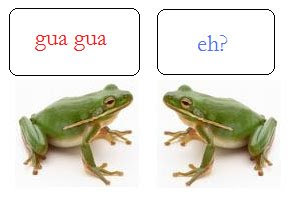
But the story doesn’t end there; dogs are not the only creatures with a language barrier to overcome. In fact, even the humble frog would have trouble chatting around an average koi pond on Chinese soil. While you may have previously thought it common knowledge that a frog communicates solely in ribbits, as you have probably now guessed, this is not the case in China. If you absolutely must imitate the Budweiser frogs while in the PRC, please ensure that the standard call of gua gua is used at all times, in order to avoid any confusion that may arise.
The confusion extends further into the animal kingdom. A patent worldwide shortage of farmyard translators has ensured that livestock destined for a future outside their home countries’ borders are in a constant state of bewilderment. Pity the poor sheep of the English-speaking world; There cries of baa baa simply don’t cut it once they’re past Chinese passport control, and are instead drowned in a sea of mie
But it is not all bad news. In fact, for cats with an international inclination, relocating to China would likely cause a minimum of disruption, having to cope with only a change of accent rather than a different language. (Go on, try to miaow with a Chinese accent.)
Confusing as this all is, the level of education among China’s non-human population demands respect – it is apparent that animals of Chinese origin are clearly familiar with the rules of standard Chinese and always use the right one of Mandarin’s four tones.
As a sad footnote, after extensive research, it has proven nigh on impossible to ascertain the sounds made by particularly Chinese beasts like the giant panda (ooh, is it a bear, is it a raccoon?) and the common or garden dragon.
Desperate to communicate with Chinese animals? Click here.