01 May 2009

Non-jobs

Looking for a career change? Consider China. Here there exist a diverse array of professions that don't even exist in the western world. 

You can often see people selling things out on the street. Puppies. Little baby chicks (ideally, these should be pink, green or blue). This month I've seen a guy, on two occassions, attempting to sell a rock. An actual rock. It was about the size of a small child's head, light grey in colour, with some dark grey circles on it.

A guy and his rock

Apparently this pattern makes it special, and therefore commands a price of something in the 4-digit range. (I sincerely hope that the guy that was selling that thing is still there - if she's not then it may indicate that someone has bought it. If that is the case, I may feel compelled to track down said buyer and beat him, or her, senseless. If only to get my hands on the rock, obviously.)

Another great job is the guy THAT PEOPLE ACTUALLY GIVE MONEY TO that will design a signature for you. Apparently it's cool to have a cool signature. Apparently people are too dumb to come up with one on their own.

Then there's the young ladies who clap for a living. Literally - clapping. Their task is to stand at the front of a shop and clap their hands together. I understand the idea behind this is simply to attract attention; once you've glanced over in their general direction, you will inevitably be drawn into the store where you will empty your wallet. I wonder what rigorous selection-procedural hoops need to be jumped through to reach those dizzying career heights.

Possibly the occupation with the largest number of workers in China also fits into the category of that's-not-really-a-job-is-it. Last, but by no means least, it is the good folks that stand by the door of so many stores and restuarants, and welcome you inside. Literally: Just stand there and say huan ying guang lin ("Welcome, and please grace us with your presence"). Then once you get inside, customers are often vastly outnumbered by the number of shop assistants or waitresses. Just ordering food in a restaurant herecan be a 3-waitress job. One to hold the menu, one to write the order, one to just stand by (in case of emergency?).

I'm told this may be partly in response to the fact that the population here is just so damn big. There aren't nearly enough jobs to go around, so jobs are just invented. In a situation like the one described above (shops, restaurants) I suspect the over-abundance of staff is meant to be a sign that the business is successful and can offer great service. 

To be fair, I once had a non-job. My sole task: to arrange files in alphabetical order.

21 April 2009

The International Language of Onomatopoeia

(Or: Would a duck by any other quack sound as sweet?)

There are certain things in life that people often take for granted. The sun rises and sets. Santa will only leave gifts for good boys and girls. Grass is green. The sky is blue. Dogs bark, birds tweet… They do, don’t they? Well, maybe where you come from, but not in China.

What sound does your dog make? Woof? Bark? In China, the word is wang (1st tone, in case you were wondering). Admittedly, the issue of whether this is standard mutt-Mandarin, or the local doggy dialect remains unclear. If you brought your non-Chinese dog to China it is possible that the poor thing would stand no chance of communicating with its oriental canine cousins.
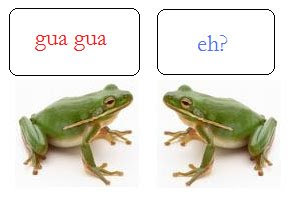
But the story doesn’t end there; dogs are not the only creatures with a language barrier to overcome. In fact, even the humble frog would have trouble chatting around an average koi pond on Chinese soil. While you may have previously thought it common knowledge that a frog communicates solely in ribbits, as you have probably now guessed, this is not the case in China. If you absolutely must imitate the Budweiser frogs while in the PRC, please ensure that the standard call of gua gua is used at all times, in order to avoid any confusion that may arise.
The confusion extends further into the animal kingdom. A patent worldwide shortage of farmyard translators has ensured that livestock destined for a future outside their home countries’ borders are in a constant state of bewilderment. Pity the poor sheep of the English-speaking world; There cries of baa baa simply don’t cut it once they’re past Chinese passport control, and are instead drowned in a sea of mie
But it is not all bad news. In fact, for cats with an international inclination, relocating to China would likely cause a minimum of disruption, having to cope with only a change of accent rather than a different language. (Go on, try to miaow with a Chinese accent.)
Confusing as this all is, the level of education among China’s non-human population demands respect – it is apparent that animals of Chinese origin are clearly familiar with the rules of standard Chinese and always use the right one of Mandarin’s four tones.
As a sad footnote, after extensive research, it has proven nigh on impossible to ascertain the sounds made by particularly Chinese beasts like the giant panda (ooh, is it a bear, is it a raccoon?) and the common or garden dragon.
Desperate to communicate with Chinese animals? Click here.

16 April 2009

Birds of a feather

There are things that I've come to understand about China. People will never believe that I like spicy food. People will respond to my spoken Chinese with mime. Mashed potato will always be served cold, surrounded by a moat of milk, with coloured sprinkles on top. I accept these things and try not to let them get me down.

But there are other things, things that I don't think I'll ever understand. I've already written about one such example, when landlords actually raise the rent after apartments have been sitting empty for months, to recoup the money they've already lost. This seems an unusual business decision to me. But there's another one, a more obvious and highly visual one, that I'm sure many others have noticed...

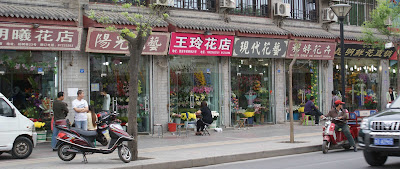
If you need to buy some flowers in Xi'an, where do you go? Flower street, of course. What about a neon sign for the front of your shop? Head on down to neon sign street. Desperately need some goldfish? Simply take a bus down to goldfish street and ye shall be rewarded. I can't help but wonder.... is it really a good idea for stores that sell identical items to be located right next door to each other in a single long strip? Often, they have exactly the same prices too. Where is the competition? How can that be a good business idea? I've heard that if a couple of similar shops, nearby to each other, seem to have a good business, then that just encourages many others to open identical shops next door.

A sign-making shop, next to a sign-making shop, next to a...

Doesn't this just dilute how much money is being brought into the available stores in that particular identi-shop strip? Once the saturation point has been reached there simply won't be enough business/money to spread around... right? Whatever happened to finding a gap in the market? Wouldn't it make more sense to find out where there are NO florists, and open one there? Well, not in China.

Six florists in this photo, but there are plenty of others nearby

The thing is, this Chinese system doesn't seem to work.... so why does it persist? 

Luck.

It's all about how lucky you are. If business is poor, the store makes a loss and has to close, then what is the cause? Location? Lack of advertising? Wrong product or pricing? Nope - the guy just wasn't lucky enough. So, sure enough, another one will open in its place a few weeks later, opened by someone that believe they will be luckier than the last one. And so the cycle continues.

There seems to be a general belief that the path to riches goes something like this:

1. Open a shop (preferably selling little crappy things that nobody really wants, which are really cheap, and can only possibly yield a profit of 1 RMB.)

2. Plan is complete - you are rich.

There are no possible alternatives or deviations from this plan. At least, not in the minds of the myriad shop owners, and potential shop owners, of Xi'an. Did you have any idea that is was so simple? Let's all go and open stores in a shopping mall right now! Oh wait, you probably shouldn't bother, since they're all empty caverns...

09 April 2009

Play, Setup, Scene, Spanial

English is fashionable in China. It has been for a number of years, and the trend is likely to continue. English words adorn many items of clothing, and translations from the original Chinese often accompany things like shop names and descriptions of food items. If it doesn't have abc on it, it just aint worth having.

I know, I know, Chinglish is an easy target. And there is already a great wealth of it available on t'internet for your viewing pleasure. But I've already largely resisted the urge for several months, and I've collected a few pictures that unreasonably amused me...

This is the menu page of a some random DVD I saw a few months ago. (You can assume that this isn't from a 100% legitimate copy of the film...) I was rather hoping that selecting the fourth option would translate the entire thing into woofs and barks, but sadly this was not the case.

This is an entry in the menu of a restaurant I often go to. I believe the translation should be something along the lines of a 'bull's penis cut into the shape of a flower', which isn't necessarily much better than what the menu actually states... but there's just something about the wording that puts a smile on my face:

Not in my family it doesn't

I imagine that many of these low-budget translations stem from the use of internet-based translation software by someone who has little or no knowledge of English... Here is an interesting illustration of what can happen when quality control really goes out the window - found in large writing on the front of a shop, somewhere between Taiyuan and Beijing:

25 March 2009

What Chinese people know about food

Only Chinese people like spicy food. Or maybe I should rephrase that as 'only Chinese people can eat spicy food', since there's an important difference. Seemingly, this is a matter of pride to folks here - the ability to eat spicy food. Non-spicy food just isn't proper food to many people. And it seems that even if you don't like the heat of the chillis, it is just the done thing, so you eat them anyway. How amusing to see people slurping down furnace-like hot and sour fishhead soup and chewing on red chilli-coated noodles while their cheeks glow pink and foreheads bead with sweat, insisting how great the food is (but all the while stopping for regular breaks and declaring how bloody hot it is). I've the question before: If it's too spicy, why not ask for it without the chilli next time? But I was politely informed that it wouldn't taste good without the tongue-searing, makes-your-eyes-bulge heat. 

I like spicy food. Chinese, Indian, Mexican - it's all good. I've tried to introduce the idea that other countries also have spicy food. I've talked about the popularity of Indian food in the UK. But ordering spicy food in a restaurant in China often produces the same response: A concerned look, then, towards my missus: 他能吃辣子不?("Can he eat spicy stuff?") For me, this is annoying on two levels. Maybe I'm taking it too personally but it almost seems like a slight against my manliness - yes I can eat spicy food damnit (just like I ate them the last ten times I ordered this dish in this restaurant...). Pile more chillies on top, see if I care. Secondly (if a little off-topic-ly) I ordered the food by speaking to the guy in Chinese, so why can't the guy ask me if I'm ok with spicy food?

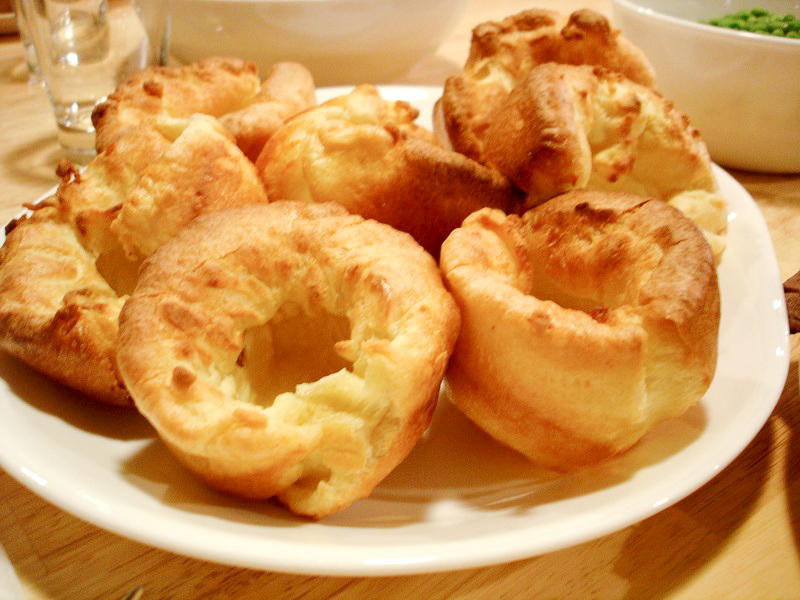
Chinese people know what foreign food is: Burgers. And pizza. And fried chicken. I think those are the only available options. I once showed some students a picture of a cooked english breakfast and they didn't even understand what they were looking at. A full Sunday-roast style dinner (complete with yorkshire puddings, naturally) produced a similar effect. Regardless of their obvious utter lack of knowledge of foreign food, I was confidently informed that foreign food didn't taste good. (Note to self: Try this again, but first Photoshop the pictures to make everything look spicy.)

Oh, I missed one. Foreigners also eat onions.

To be fair, knowledge of what real Chinese food is is pretty pathetic in the UK. Most things that you might find on a menu back home simply wouldn't be recognised as Chinese food in China. Likewise, there's a lot of great Chinese food that I can't imagine I'd ever find in a restaurant back in England. 

The range and standard of 'western' food here is not great, though probably on a par with the range and standard of Chinese food available in western countries. Some of the 'western food' items I've been served - though I haven't necessarily eaten - include pasta (served in a ketchup dressing) and fruit salad (served in a thousand island dressing). Pizza has no tomato under the cheese. But at least the cheese is... cheese flavoured. Could be worse, could use one of these dairy-related abominations:

That'll be strawberry and chocolate flavoured cheese then. Say it with me: Mmmmmm.....

18 March 2009

The Shaanxi Squat

Back in my school days I remember spending a lot of time sitting cross-legged on the floor. During school assembly, or at home in front of the TV. It seemed comfortable at the time, but my aging, unexercised lower limbs just don't have the required flexibility any more. I can bend to meet all the necessary angles required to sit on a chair, and that's about as far as I go.

Life in China makes more demands of peoples' thighs. What with all the stair climbing (buildings of eight floors or less have no lifts) and walking, and... well, I won't dwell too long on the delights of a visit to a non-Western style WC, but as you can probably work out from this picture it doesn't involve sitting down, but requires the 'user' to squat. 


Moving swiftly on, I'm focussing on the act of squatting itself. Chinese people are great at this. If it was an Olympic sport, then that would surely have been another gold medal in the bag for the PRC. It can be seen everwhere: In the street, at home, in school. Waiting, smoking, chatting with friends, eating. On the ground, on a wall, beside a chair, even on a chair...

Spotted this guy a couple of days ago in a local restaurant, thought I might sneak a quick photo using my phone, over my shoulder.

I don't know why, but although I've seen people squatting like this wherever I've been in China, it does seem more common here in Xi'an. Therefore, I propose that henceforth this manouvre be known as The Shaanxi Squat. I'm fairly good at it too, though I find it difficult to hold for long periods of time. I've yet to work up the courage to attempt an on-seat squat, but maybe one day...

Sorry, more toilet talk, but this warrants a mention too: On a couple of occasions I've seen footprints on the seat of a western-style toilet. No need, really.

09 March 2009

Be careful the safe

What better way to escape from a Wednesday afternoon at work than to be carted off to a health and safety workshop? I'm certain this is a familiar scenario to people all over the western world. Sadly, no such thing would ever happen in China, the land of blatant disregard for human safety (in spite of the occasional redundant sign).


Traffic lights are just for decoration, right? (I've personally witnessed at least half a dozen car crashes over the past couple of years, compared to one in my previous 28 years in the UK.) Hiking up mountains is aided by "safety rails" that are barely up to knee-height... more of a trip-hazard really. How many people can you fit on a motorbike? Come to China and you'll find out. Having said all that, it is actually quite refreshing to be in a country where daily life has not had all the fun thoroughly beaten out of it with a large and pointy health and safety regulations stick. I rather enjoy careering around the streets of Xi'an on the back of someone's moped. (I try to forget that driving lessons are optional here... Want a license? Just buy one.) A small part of me (not my lungs, obviously) loves that it is ok to smoke anywhere you like. Including in hospitals. (But I don't like it in lifts.)

The street where I live is populated by many businesses that make neon signs for shops. As such, there's always work going on out in the streets. (If there's not enough room inside, they just drag everything outside onto the pavement and do it there.) I don't entirely love the smell of burning plastic that fills the air, but I do marvel at the guys welding the metal sign-supports together. Welding masks? Ok, what about goggles? Why bother when you can just turn your head away? Has anyone really thought that through? Welding, whilst not actually looking at what you're welding? (Hmm... Maybe I've found the reason why Xi'an has a hospital that specialises in reattaching severed hands!)

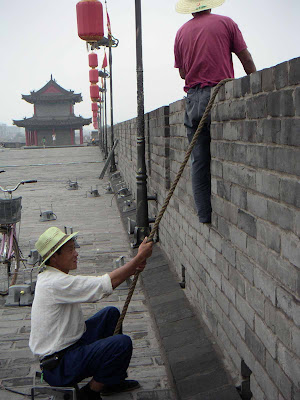
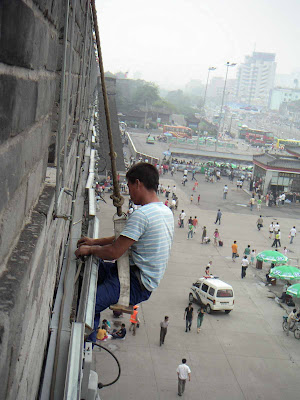
Possibly my all-time favourite example of lack-of-fear-of-potential-death in China was also witnessed right here in Xi'an. These are some pictures from the first summer that I arrived here, in 2007. I was walking atop the ancient wall that encloses the city centre when I noticed this guy sitting on his little stool, hanging onto a rope, which disappeared over the other side of the wall...

He looked a little nervous as he smiled casually at me. I tried to just walk by. It was none of my business what he was up to. I walked. I walked some more. I thought I'd made it, but I just had to look. It was like trying to ignore an itch - I just had to look. I walked towards the side fo the wall and stuck my head through so that I could see outside. What was on the other end of that rope?

Well, I suppose it was easier and significantly cheaper than to hire some kind of lifting platform to hoist him up from the ground on the outside of the wall. Practical, don't you think?
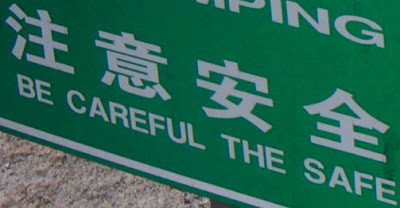
Remember kids: Be careful the safe.